
This a testimony submitted by Hannah Saggau, Stand.earth Senior Climate Finance Campaigner, to the New York City Banking Commission to vote against major fossil fuel financing banks as Designated Banks.
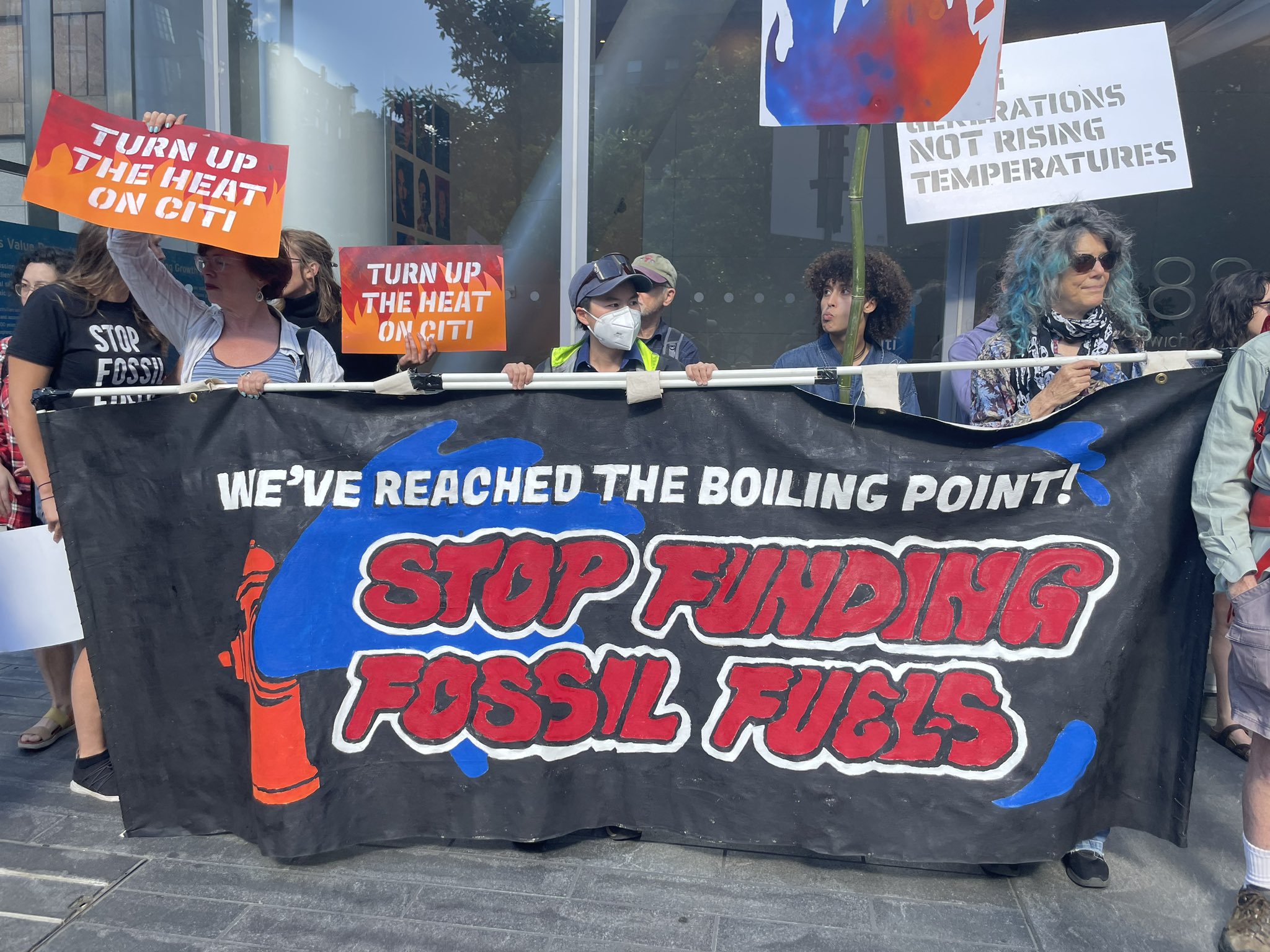
This testimony is being submitted on behalf of Stand.earth’s Climate Finance program. Stand.earth is an international nonprofit environmental organization with offices in the United States and Canada with more than 1 million supporters. For more than twenty years, we’ve been utilizing cutting-edge research, building equitable power with frontline communities, and leveraging mass movements to make a real impact on the health and wellbeing of our planet. The Climate Finance program works to hold global banks accountable for exacerbating the climate crisis and human rights violations through their outsized fossil fuel financing and underfinancing of climate solutions.
On behalf of Stand.earth, I urge the Commission to vote against naming Wells Fargo, Citibank, Bank of America, JP Morgan Chase, Santander, or TD Bank as NYC Designated Banks due to their irresponsible financing for the fossil fuel industry. Banking with major fossil fuel financiers poses significant fiscal risks to the City and its residents that the Commission should take into serious consideration. In particular, we strongly recommend that the Commission vote to not allow Wells Fargo to do business with New York City, as the first major U.S. bank to drop its 2030 and 2050 climate targets for its financed and facilitated emissions, in one of the most dangerous instances of banks rolling back their climate commitments under the climate denying Trump administration.
Citibank, Wells Fargo, Bank of America, JP Morgan Chase, Santander, and TD Bank have collectively committed financing for the fossil fuel industry of over $1.7 trillion since the Paris Agreement was signed in 2016. This includes over $791 billion in financing for the top companies expanding fossil fuel production from 2016 to 2023, despite the International Energy Agency’s clear directive not to invest in new fossil fuel development after 2021.
If New York City does business with major financiers of fossil fuels, they are putting New Yorkers’ money at significant risk: Citi’s own analysis submitted to the Federal Reserve, for example, concluded that they could suffer up to $10 billion in loan losses as the world transitions to a clean energy economy, because of the bank’s outsized exposure to fossil fuels. This threat is similar for other major fossil fuel financing banks, and doesn’t just threaten those banks’ financial stability, but the entire economy. Major banks’ massive exposure to fossil fuels and failure to rapidly de-risk their portfolios could trigger a 2008-style financial crash in the event of rapid devaluation of fossil-fuel-linked assets, where Wall Street elites are bailed out and working people are left to suffer the consequences. New York City can mitigate this risk in part by moving its money out of the most fossil-fuel-exposed banks.
Despite banks rolling back their climate commitments publicly, climate-related financial risks are not going away, and New York City has a responsibility to its residents to take these risks seriously when deciding on its designated banks.
Out of these banks, Wells Fargo’s decision to abandon its financed emissions reduction targets sets it apart as a laggard among its peers, in one of the most alarming moves amid a trend of banks backsliding on climate. All of the other major U.S. banks, though they continue to commit billions of dollars in financing for the expansion of fossil fuels, as a minimum have committed to reaching net zero emissions by 2050, including for their financed emissions, and have set 2030 emissions reductions targets for the energy and power sectors. Wells Fargo is one of the world’s largest fossil fuel financiers, committing over $296 billion to the industry from 2016-2023 (according to the most recent data). For 2023, Wells Fargo is the fifth largest global funder of fossil fuels, and it committed $48.47 billion to fracking companies since 2016, as one of the sector’s top funders.
Further, Wells Fargo is significantly underfinancing renewable energy relative to fossil fuels, with nearly twice as much financing for fossil fuels as low carbon energy, according to Bloomberg New Energy Finance. According to the IEA, the ratio of financing for low carbon energy relative to fossil fuels needs to reach 6:1 by 2030 in order to reach global climate goals. Wells Fargo’s is 0.52:1. Wells Fargo’s management even recommended that shareholders vote against the resolution filed by the NYC Comptroller’s office requesting disclosure of this metric. JPMorgan Chase and Citi, meanwhile, committed to disclosing their energy finance ratios last year.
Additionally, Wells Fargo’s history of egregious mismanagement and scandals makes it a risky bank for New York City to do business with. The bank is under heightened regulatory oversight and scrutiny, including for its role in the 2008 financial crisis, inadequate controls on money laundering and other financial crimes, the bank’s 2016 fake accounts scandal, which triggered billions of dollars in fines, an asset cap, and a class action lawsuit. The Trump administration poses a serious threat of dangerous de-regulation, exposing Wells Fargo’s clients to further risks. In November 2024, Senator Elizabeth Warren urged the Federal Reserve not to lift the bank’s asset cap, citing ongoing misbehavior.
Among the global banks under consideration, Spanish bank Santander is notable because its financing in the sensitive Amazon Biome (Amazonía) has been rapidly growing in the last 5 years, establishing a dangerous trend in the wrong direction. According to Stand.earth’s latest Amazon banks database update, from 2009 to 2023 Banco Santander committed an estimated $1.405 billion to the financing of oil and gas in Amazonia, fueling the growth of problematic extraction at the same time that Indigenous leaders and scientists warn the rainforest is in a tipping point crisis. Data from Stand.earth Research Group shows Santander is the world’s fifth largest financier of Amazonian oil and gas, and the largest financier among EU banks.
The bank’s rapid growth of financing is mostly thanks to recent direct financing to Petroperú’s problematic Talara refinery expansion, affecting Indigenous communities and Ramsar protected areas, as well as financing of the Brazilian Azulão Field, which license was requested for the suspension by the Brazilian Federal Public Prosecutor’s Office due to the disregard for the presence of Indigenous peoples in the region.
Further, Santander is one of the biggest financiers of the soy industry, connecting its financing to slave labour and deforestation of some of the most critical biomes in Brazil. It is also worth noting that Santander UK reportedly held bank accounts for front companies that helped Iranian entities evade US sanctions, demonstrating that it is a bank with poor controls against money laundering and one that NYC should avoid.
As a low-lying coastal city, New York is uniquely exposed to worsening climate disasters, including deadlier heat waves, sea level rise, and more intense and frequent storms. More than 80,000 New York homes could be destroyed by floods, which are worsened by global heating, in the next 15 years. These disasters will harm Black, brown, and low-income New Yorkers the most: heat wave-related deaths over the past decade are twice as high among Black New Yorkers, for example.
If the Commission votes to name Wells Fargo, Citibank, Bank of America, JP Morgan Chase, Santander, or TD Bank as NYC Designated Banks, the city’s money will be used via loans and underwriting to finance top climate polluters that are driving catastrophic climate impacts for New Yorkers and globally. Research on the climate impact of cash deposits estimates that every $1 billion in cash that a bank deploys generates the emissions equivalent of 63,793 gas-powered vehicles’ annual emissions. Depositing the city’s money into any of these fossil fuel banks would undermine the city’s climate goals by financing fossil fuel expansion. Further, it would contradict other actions by the city targeting financed emissions, including the recent commitment by three of the city’s pension funds to evaluate the climate plans of major asset managers or risk losing their business, and the pension funds’ completion of $3 billion in divestment from risky fossil fuel assets.
Choosing where to put New York City’s funds is a choice between putting its cash towards a safe climate future, or allowing it to drive more extreme weather in New York and around the world. Wells Fargo, Citibank, Bank of America, JP Morgan Chase, Santander and TD Bank are among the world’s largest funders of fossil fuel expansion. I urge the Commission to vote against certifying these institutions, especially Wells Fargo, as NYC Designated Banks.
Hannah Saggau
Senior Climate Finance Campaigner, Stand.earth
Media contact: Lindsay Meiman, lindsay@stand.earth

How Banks help Big Oil raise money through the bond market

Banks and shareholders are falling in line with the Trump regime on climate and human rights, but you can hold them accountable with us.
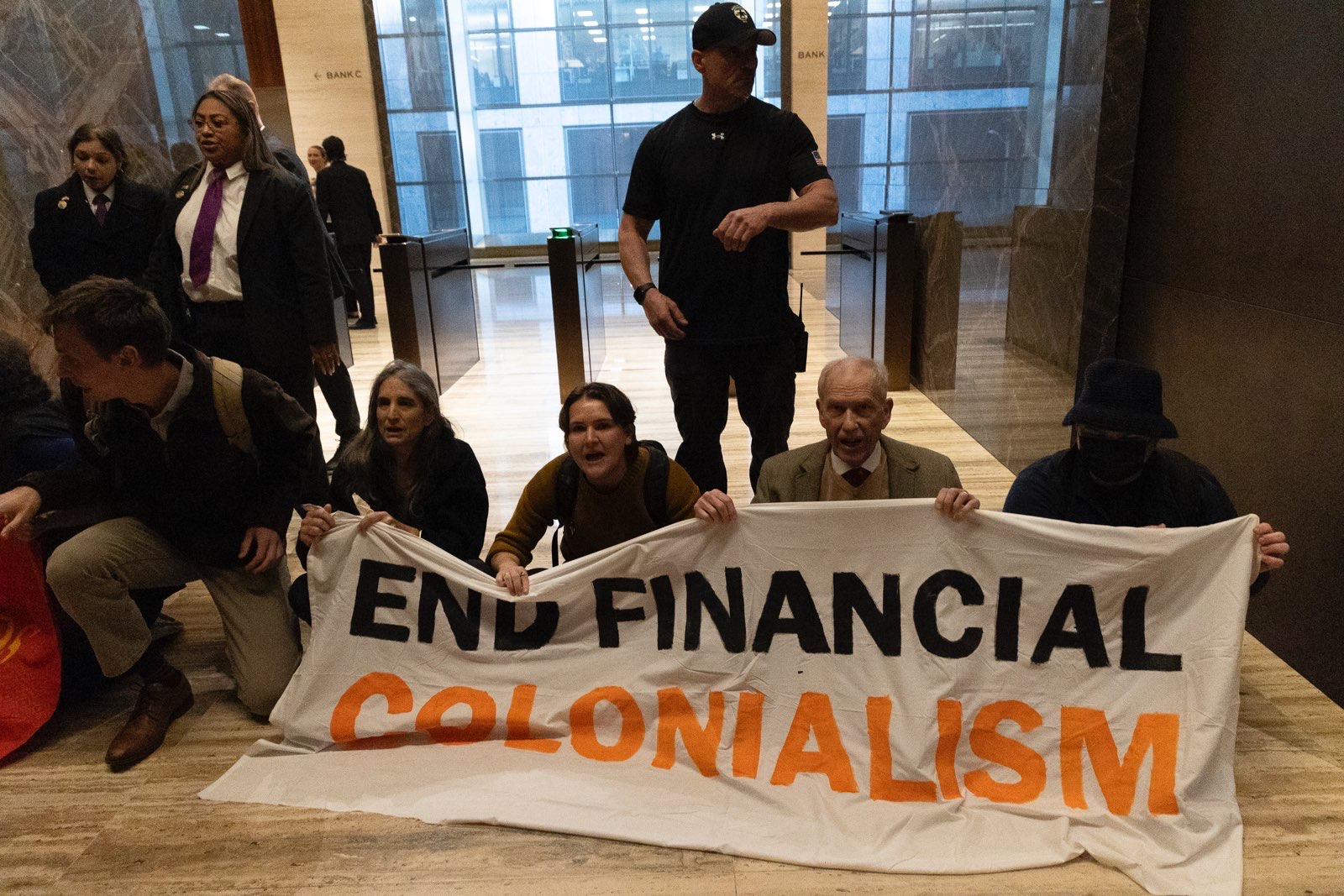
Declining support for the proposals signals that investors are falling in line with the Trump regime’s attacks on human rights and climate

Managed by Stand.earth & built by 89Up